
If you run data services at an MLS, you know the monthly ritual. You approved a stack of vendor contracts last month. A deposit lands from your payment processor. And now you’re holding two documents that refuse to agree with each other, trying to answer a question that sounds like it should take five minutes:
Did every active connection actually get billed according to its contract terms?
It rarely takes five minutes. It takes an afternoon, a spreadsheet, three browser tabs, and sometimes a follow-up email to your vendor rep. And many MLS staff members have quietly wondered whether they’re overcomplicating it.
You’re not. The tools are.
Why Reconciliation Is So Painful
The root problem is architectural. In most MLS setups, feed distribution lives in one system and payments live in a separate, generic payment processor. Those two systems were never designed to reconcile against each other. One knows about connections, the other knows about deposits. Neither knows the full story.
That gap creates three predictable headaches:
- The report is organized around the wrong entity. Most billing exports are built around the party that was charged, not the contract that was approved or the broker who signed it. So when you try to trace a payment back to an approval, the connecting thread isn’t in the report. You have to rebuild it by hand.
- Partial-payment months are invisible. Say you approved 15 contracts with a single vendor last month, and the deposit covers 8 of them. Which eight? The deposit total tells you an amount, not an identity. There’s no line item that says “these eight connections, billed under these contract terms, paid…but these five, still open.” You reverse-engineer it, line by line, hoping the math lands.
- Approvals and billing drift apart. A contract approved in one system doesn’t automatically become an invoice in the other. Somewhere in the handoff, connections get approved but never billed, or billed at the wrong terms, and nobody notices until the numbers don’t tie out at month-end.
None of this is a staffing failure. It’s what happens when the system of record for access and the system of record for money are two different systems.
The Answer: One Record, End to End
The reason reconciliation is hard is that the answer lives in several places at once. The fix is to put it in one.
That’s the core design principle behind RealtyFeed’s MLS Router™. Instead of a feed platform bolted onto a standalone payment processor, MLS Router™ is a single system of record where the contract, the connection, the broker signer, the charged-to vendor, the feed configuration, the usage, the invoice, and the payment status all live on the same record.
Here’s what that changes about the questions above.
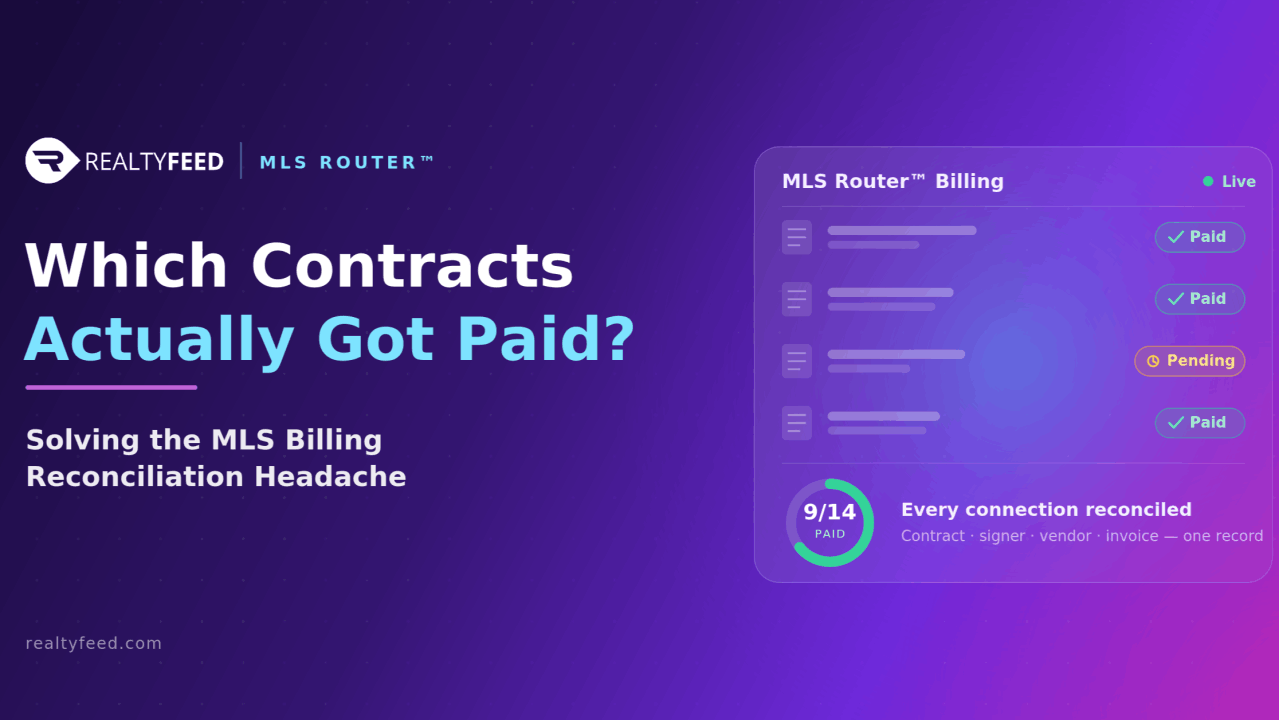
“What report verifies that every active connection was billed correctly?” You’re no longer cross-referencing two exports that don’t share a key. Because billing is generated from the same entitlement that governs the feed, every active connection carries its own billing status inside the platform. The invoice dashboard shows paid, unpaid, and cancelled invoices in one view, tied directly to the contracts that created them, so verification becomes a glance rather than an investigation.
“The report only shows the charged-to vendor, not the broker signer.” Both live on the record. MLS Router™ lets you store files and context at both the contract and the vendor level, so the signer, the entity being charged, and the paperwork behind the relationship are all attached to the same connection, not scattered across systems.
When San Diego MLS moved to this model, their Data Services Coordinator described the result as a complete “soup-to-nuts” operational lifecycle in a single system of record, from the first vendor inquiry through automated contract execution, usage-based billing, and ongoing licensee management. That’s the practical difference: the reconciliation problem doesn’t get easier to solve, it stops existing. Check out the full SDMLS case study here.
Automated Billing That Reconciles Itself
Moving billing into the same platform as your feeds does more than make month-end auditable. It removes the manual handoffs where errors are born.
MLS Router™ automates monthly invoicing and collections (powered by Stripe), which eliminates the gap between “contract approved” and “contract billed.” An approved connection generates its invoice on the terms it was approved under, on the cycle you set. In the SDMLS case study, that shift produced improved billing accuracy through automation, a move from quarterly to predictable monthly cycles, and monthly feed revenue that more than doubled, all without adding staff.
The Broader Administrative Lift
Billing is where the pain shows up most sharply, but it’s a symptom of a larger reality: MLS staff are managing a growing ecosystem of vendors with tools that were never built to manage relationships at scale. MLS Router™ was built to carry that weight:
- Vendor management with a built-in CRM and full log history, so every interaction, approval, and change is tracked in one place instead of living in someone’s inbox.
- Two-way messaging tied to each contract, so vendor communication happens against the record it concerns, not in a separate thread you’ll struggle to find later.
- Document storage at the contract and vendor level, keeping agreements and signer details attached to the connection they govern.
- Real-time usage tracking and governance, giving you clear visibility into who has access to what data, for what purpose, and whether their usage matches their entitlement.
Put together, this is the shift from managing data distribution as a pile of manual exceptions to running it as a governed, auditable line of business, with far less staff time per vendor and far more confidence at month-end.
Stop Reconciling. Start Governing.
The monthly reconciliation scramble isn’t a sign that you’re doing something wrong. It’s a sign that your access system and your billing system were never introduced to each other. Connect them, and the question “which contracts actually got paid?” answers itself, every cycle, without the spreadsheet and the follow-up email.
MLS Router™ is available today, not on a roadmap, and MLSs are already running their entire vendor and billing lifecycle on it. If reconciliation season is eating your afternoons, we’d love to show you what it looks like when it doesn’t. Let us know and we’ll set up a demo.