
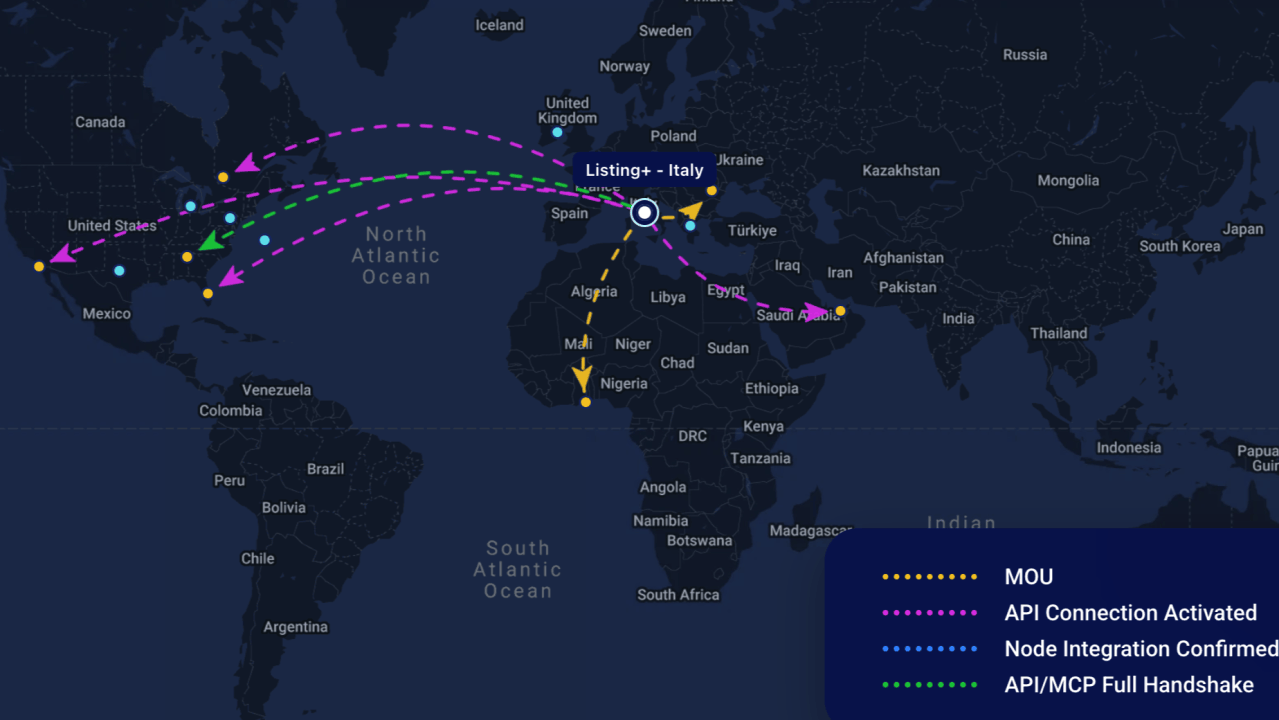
Real estate is local, but its reach is global.
Last week at the Real Estate Standards Organization (RESO) Fall Conference in Colorado Springs, I had the pleasure of sharing the stage with Melissa King , COO of OneKey® MLS , for a session called Global Challenges and Opportunities. We opened with a world map. Then we went straight at the elephant in the room: with so much going on at home, why should MLS leaders pay attention to global?
Our short answer: because the market already does. Buyers, sellers, brokers and tech companies cross borders every single day. What they need is data that crosses with them. Data that speaks a language every system understands, and that’s accurate enough to trust from the other side of the world.
Everyone wants the same thing: connectivity
RESO standards now reach 44 countries, each with at least one organization or company that’s a RESO member. And nine new international members joined in 2026 alone.
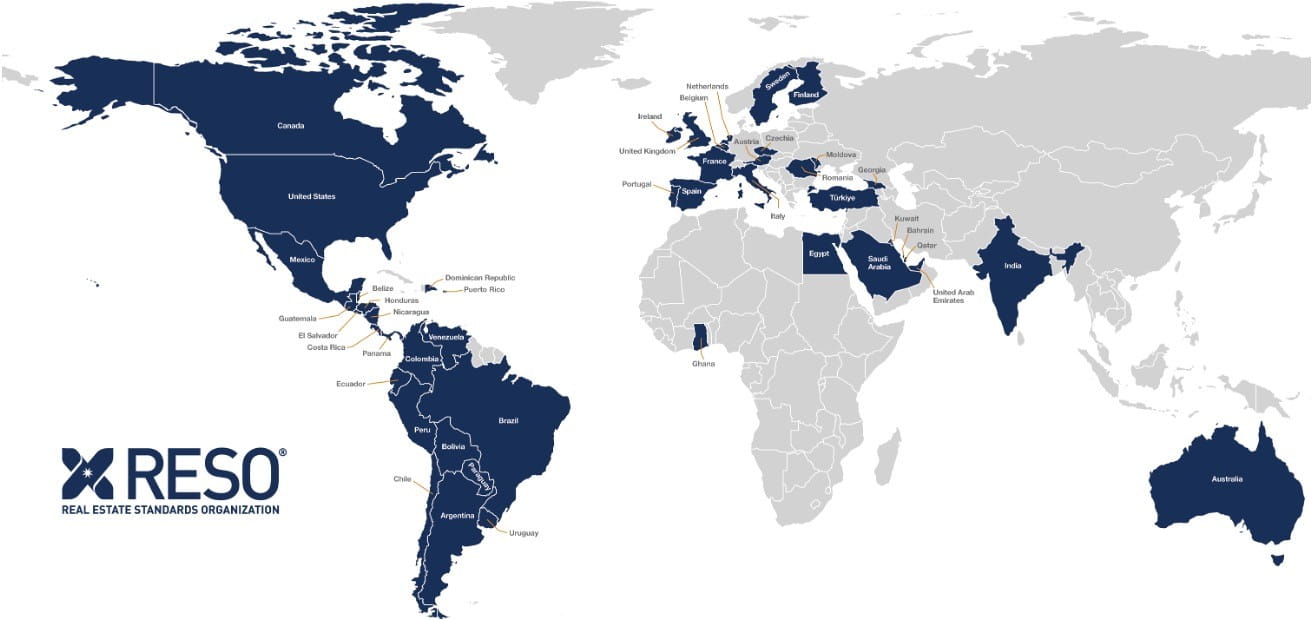
Look at who’s joining and you’ll see a mix of organizations. A few example from this year include: EPPA, the Hellenic Association of Certified Real Estate Experts in Greece; Listingplus.it, an MLS in Italy; Information Technology Systems Ontario (ITSO), which manages MLS® technology for associations in Ontario; and Lumina Estate, a real estate AI company in Georgia (the country).
Different businesses. Different countries. Same ask: connectivity. MLS, portal, brokerage or proptech, it doesn’t matter. Everyone needs a common language so they can put their data to work. The International MLS Forum, which has become an annual event, is more proof that the interest for global connectivity and standardization is growing.
Many members in the U.S. are already global. According to NAR’s 2026 International Transactions in U.S. Residential Real Estate report, foreign buyers spent $45.3 billion on U.S. residential real estate.
There’s also a simpler reason global matters. RESO is a technical standards body, a bit like the folks behind Bluetooth. Nobody would care about Bluetooth if it only worked in one country. A standard proves its value by working everywhere, and every new market that adopts it makes it stronger for the MLSs that built it.
When the buyer is 5,000 miles away, accuracy is everything
A local buyer can fix bad data with a Saturday drive. They tour the apartment, count the bedrooms, step out onto the terrace. A buyer 5,000 miles away doesn’t have that luxury.
For that buyer, the listing is the property, at least until they get on a plane. Every field has to mean exactly what it says: the price, the currency, the bedrooms, the property type, and what they’d actually own. A small mapping error that a local agent would catch in two seconds can send an international buyer to the wrong home.
That’s why verified listings and certified data matter more across borders than anywhere else. RESO Certification tells a partner on another continent that your data follows the standard, field by field and value by value. As more markets certify, I believe it can become the global trust mark for real estate data. A trust mark that is recognized and that consumers and professionals look for.
Every market is different, and that’s where it gets interesting
Every market counts rooms its own way, names property types differently, handles unique ownership models, and so on. Shout out to RESO, they’ve been chipping away at these local nuances over the years and capturing them in the Data Dictionary.
The internationalization of the Data Dictionary is underway
Data Dictionary 1.7 was fully translated into Spanish, and that work carried over into 2.0 when it was translated into Canadian French. So if you’re launching a bilingual website for buyers who search in Spanish or French, and that’s a lot of North and South America, you already have a foundation to start from.
And it’s not just North America. Madhmoun MLS in Abu Dhabi started with an English-to-English mapping. Listing+ in Italy mapped Italian to English, so Prezzo = ListPrice, and so on. Both are now RESO-certified. Mapping fields is a lot of work, but it can be pretty straightforward.
The values underneath those fields are where every market gets interesting. Here’s a simple example. In North America, we count bedrooms. In much of Europe, they count rooms, so every habitable room except the kitchen and bathrooms. As a result, the bedroom count often isn’t in the source data at all. Let’s look at Italy:

Now picture a U.S. buyer filtering for three bedrooms. If we map “three rooms” to “three bedrooms,” we’ve just sent that buyer to the wrong apartment. Not a great first impression.
Property and ownership types are another great example. Some have no clean match in RESO today, and a few have no field at all:
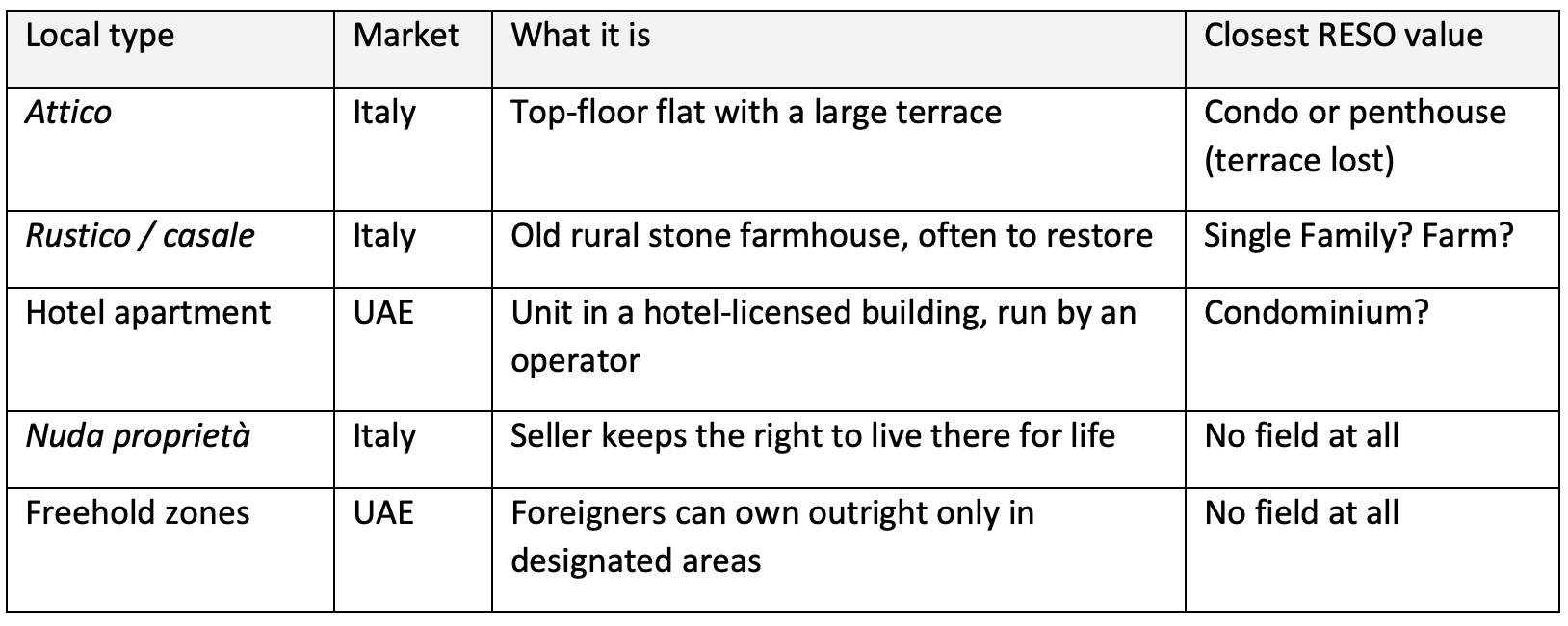
Take the attico. The closest English word is penthouse, but an Italian buyer expects an attico to come with a big terrace. A North American penthouse only promises the top floor. Or the hotel apartment in the UAE: Dubai alone has about 25,500 of them, and owners typically get only a few weeks of personal use a year. Map that to “Condominium” and a buyer in Toronto sees an ordinary condo. And with nuda proprietà, the price reflects the seller’s right to live there for life. Get any of these wrong and that 5,000-mile buyer is misled.
The standard is growing to meet the world
None of this gets solved by accident. RESO’s Global Subgroup, led by Ethan Bailey and Jason Darrough, meets regularly to work through exactly these kinds of questions, and every mapping makes the dictionary a little more global for everyone. The results are already showing up. The Data Dictionary Workgroup has approved several global fields for Data Dictionary 2.2:
• CurrencyType: ISO 4217 codes (USD, CAD, EUR) on every price.
• BuildingNumber, NumberOfEntrances, Stairwell: find the right unit when a street address isn’t enough, common in Austria, Spain, France and Italy.
• HeatingAccess, ElectricAccess, HotWaterAccess and CoolingAccess: whether heat comes from the building, a district energy network or a mix, a real difference in cost and comfort.
• Kilometers: now a standard linear unit.
What becomes possible: GDX as a working example
So what happens when one standard works everywhere? Cross-border data exchange stops being a custom project. The GDX – Global Data Exchange is a good example of what that looks like in practice.
GDX is a node-to-node network, built by RealtyFeed on RESO standards. Each MLS stays the licensor. It sets its own permissions, decides who receives its listings, and chooses which local agreement a partner has to sign. The recipient gets one clean, RESO-standardized feed across all of its approved connections.
And here’s the key point: GDX simply doesn’t exist without a common language. It’s built on the Data Dictionary and the Web API, so every participant’s data arrives in a format everyone else already understands. That’s the payoff for all the mapping and certification work I described above.
The best part? The use cases are already taking shape:
• Bilateral exchanges. One example is FMLS and Listing+ in Italy who are running a pilot using MCP, a governed API handshake that will let their networks of professionals’ exchange and work with property data using their preferred LLMs.
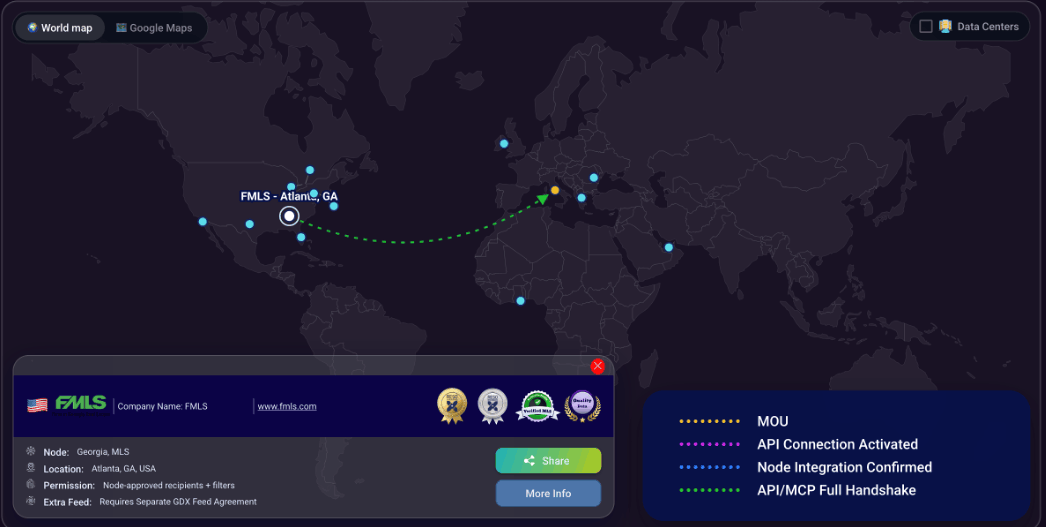
• Global search on MLS websites. A GDX plugin is now available and lets MLS embed global search on its public website or member environment. A demo site, so you can see what global listings look like on a single UI, is live at gdxlive.com.
• Global inventory for members (coming). A future plugin will let members bring global inventory to their own IDX websites.
And this is just the start. Once data is standardized globally, cross-border referral networks and international portals built on certified data become practical too. One more thing worth knowing: joining GDX is free for RESO members who contribute their listings.
Local authority, global opportunity
Global isn’t coming. It’s here. Your members are already serving international buyers, and markets around the world are adopting the same standards you helped build. The real question is whether your data is ready to travel.
Melissa and I closed our presentation with three asks:
1. Get certified on Data Dictionary 2.1. Certified data is what a buyer 5,000 miles away can trust.
2. Join the RESO Global Subgroup or the Data Dictionary Workgroup. Your local knowledge makes the standard work for everyone.
3. Connect through GDX. If global is in your strategic plan, it is the simplest way to start.
And come join us at the International MLS Forum in Istanbul, November 16–17. Prague is next, in 2027. I hope to see you there.
A big thank you to Melissa and the OneKey® MLS team for sharing the stage, and to RESO and the Global Subgroup for all the work behind the scenes that makes this possible.
Patrick Pichette is CEO of RealtyFeed.